A four-minute read. Every Insight Visit request and every volunteer application confirms that you have read this Code in full and accept it.
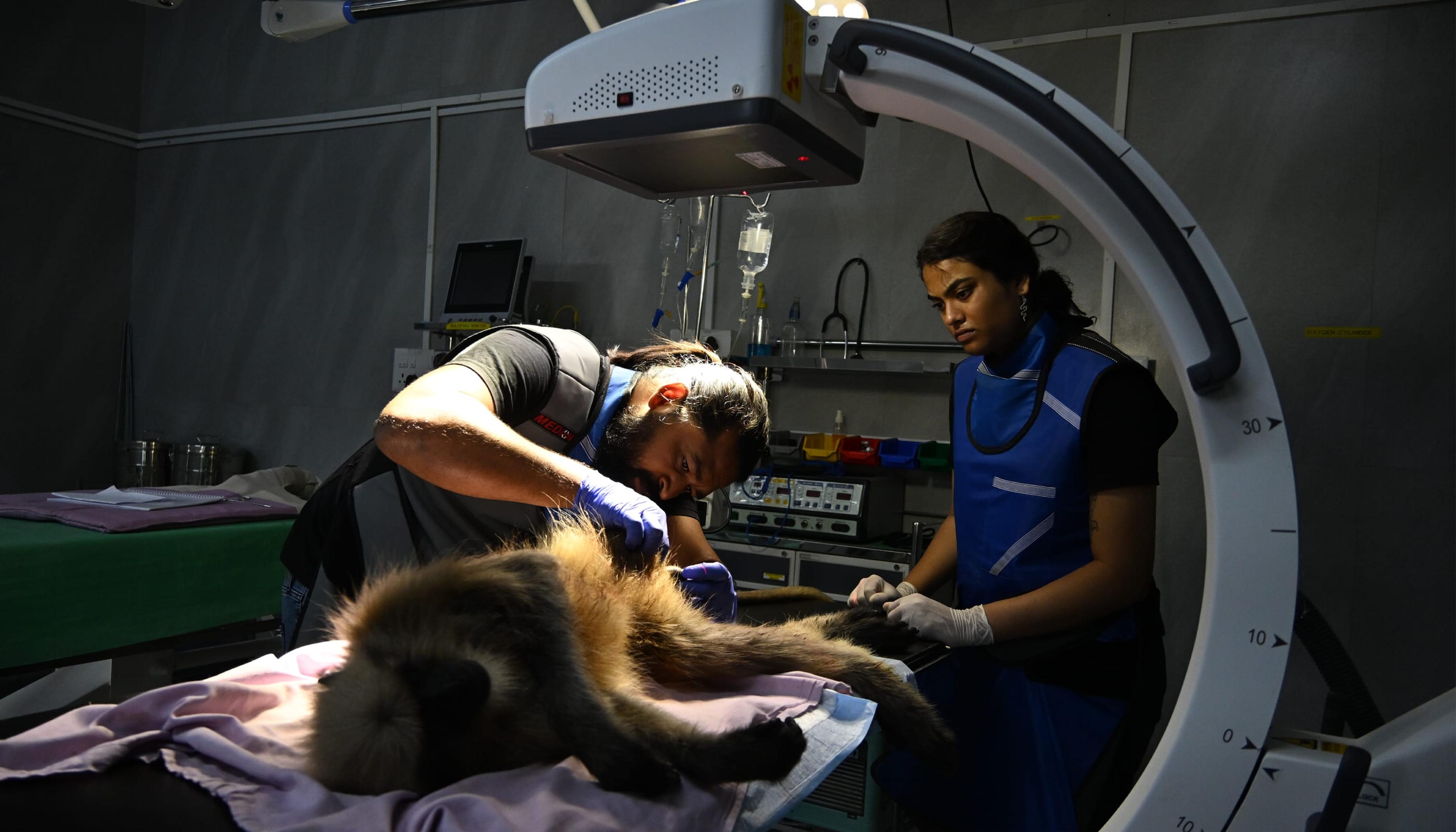
Our centres are Transit Treatment Centres, operating in formal partnership with the Maharashtra Forest Department. Every wild animal here is held under the Department's permission, for one of two reasons: it is receiving treatment, or it is being prepared to return to the wild.
There is no third reason. No animal at RESQ is here to be on display.
We say this at the outset because it explains everything that follows. The rules on this page are not house style, and they are not there to make your visit feel exclusive. They exist because the difference between an animal that goes home and an animal that never does is often a matter of how much time it spent near people, and how comfortable it became with them.
Wild animals are not frightened of humans by instinct alone. Fear is maintained by experience. A monkey that spends six weeks in a place where humans are quiet, distant and uninteresting keeps its wariness intact. A monkey that spends six weeks being photographed, spoken to and watched at close range learns that people are harmless, and that people are associated with food.
If released, the monkey will approach a village, or a tourist group. It will try to get food from the people around it. If it doesn't get what it wants, the friendly or bold behaviour will turn into a conflict that could harm both the monkey and the people.
This is called habituation, and it is the most common way a rehabilitation fails. It is caused by kindness far more often than by cruelty.
Stress works in the same direction, and faster. An animal recovering from a fracture, a snare injury, a burn or an orphaning is spending its physiological reserves on healing. Repeated proximity to an unfamiliar species, which is what you are, diverts those reserves into vigilance. Recovery slows. Some animals stop eating. Some injure themselves against enclosure walls.
You will not see any of this happening. That is precisely the problem. An animal that has frozen and gone quiet looks, to a human, like an animal that is relaxed.
This is why RESQ operates a minimal intervention and hands-off policy, and why it applies to everybody on site, without exception and without seniority.
What this means for your time here. Many of our patients are housed out of sight, deliberately. Some enclosures you will not approach. Some animals you will not be told the location of.
If you leave RESQ having seen four species and understood how a rescue is run, how a fracture is repaired, how a released animal is chosen and tracked, and why a housing society's response to a snake determines whether anybody gets bitten, then your time here has worked exactly as intended.
The animals recovering best are usually the ones you never saw.
For volunteers and interns
Why you are here. You are here to work, and specifically to do work that RESQ needs done, on the days and in the areas where it needs doing. Much of it will not be the work you imagined, and occasionally it will not be interesting. You will chop food, clean, build enrichment, prepare enclosures, record data, carry things, and repeat tasks that seemed straightforward the first time and less so the eleventh.
Much of what keeps wild animals alive is unglamorous, physically demanding, and invisible in photographs. If you are looking for a placement that will feel meaningful in the moment, this may not be it. If you are looking for one that is meaningful, it is.
It is not a qualification. Time spent at RESQ does not make you competent to rescue, restrain, treat, house or rehabilitate a wild animal, and it does not authorise you to do so. Every animal you see here is held under specific permission from the Maharashtra Forest Department under the Wild Life (Protection) Act, 1972. Nothing you learn here transfers to your home, your terrace, or your neighbourhood.
We state this plainly because the pattern is real. People leave placements like this one, find an injured bird a month later, and keep it. The bird dies, usually slowly, of something preventable, in the hands of somebody who meant only good.
If you find an animal in need, call +91 91725 11100.
Reliability. If you have committed to a day, please come. Rosters are built around you, and an absence is absorbed by somebody who was already fully occupied.
Deference to instruction. In every task, on every day, the person supervising you has the final word, and you follow it first and question it afterwards. This is not hierarchy for its own sake. Around anaesthetised animals, restrained animals, and animals in transit, a delayed instruction is a dangerous one.
Honesty. If you do not know how to do something, say so. If you have made a mistake, report it immediately, including mistakes involving animals, medication, doors, gates and locks. Nobody at RESQ has ever been penalised for reporting an error quickly. The alternative has cost animals their lives.
RESQ Charitable Trust reserves the right to modify, restrict, or terminate a participant's involvement at any time, where concerns arise around conduct, health, safety or compliance. Decisions taken by RESQ are final.
There is no warning system and no negotiation on the day. Where a placement is ended, RESQ may decline future requests from the individual, and where a group is involved, from the organisation that sent them.
We recognise how severe that reads. It is severe because the cost of the breach is not borne by you. It is borne by an animal that loses its wariness, its recovery, or its release, and by the team that spent months on it.
RESQ does not exist to change how you feel about animals. Most people arriving here already like animals a great deal. That is why they came.
RESQ exists because liking animals is not sufficient, and is occasionally the problem. The conflicts we manage are almost never caused by people who wish wildlife harm. They are caused by people who feed a monkey, keep a fledgling, photograph a leopard from a rooftop, or crowd a rescue site to see what was found in the well.
If you leave understanding that, you will have taken away the only thing here that is genuinely ours to give.
Acknowledgement. By submitting your request or application, you confirm that you have read this Code in full, that you accept it, that you understand your visit or placement may be modified, restricted or terminated immediately if it is not followed, and that you understand the purpose of your time at RESQ to be the support of wild animals in recovery, and not your proximity to them.