Volunteer with RESQ
Volunteers and interns work alongside our full-time teams on animal care, enrichment, enclosure upkeep, documentation and rehabilitation. CAMP is not volunteer tourism: it is a learning pathway, built on observation, participation and accountability, in that order.
Good to know
Applications from India are open. International placements are paused for now.
Find your way in
| Internship | General volunteering | International placement | Corporate team day | |
|---|---|---|---|---|
| Who it is for | Students of veterinary, ecology, biology and allied subjects, or anyone wanting a structured placement | People living near our centres who can help on the days we need them | Vets, technicians and students from abroad, through Worldwide Vets | Company teams, often partners of RESQ |
| How long | A fixed block of 7, 14, 21 or 28 days | At least 50 hours within three months, on the days we call you in | A fixed block of 7, 14, 21 or 28 days | One day |
| Age | 13 and over, with conditions | 13 and over, with conditions | 18 and over | Adults |
| Track | Veterinary or Applied Wildlife Management | Applied Wildlife Management | Veterinary or Applied Wildlife Management | None: hands-on facility and enrichment work |
| Cost | None; residential stays are charged | None | Set by Worldwide Vets | None; supplies from our wishlist welcome |
| How to start | Apply online | Apply online | Paused for now: write to camp@resqct.org | Write to camp@resqct.org |
Internship or general volunteering (India): one application form covers both; you choose inside it.
International placement: applications are paused for now. Write to camp@resqct.org and our volunteer manager will guide you, or see Worldwide Vets.
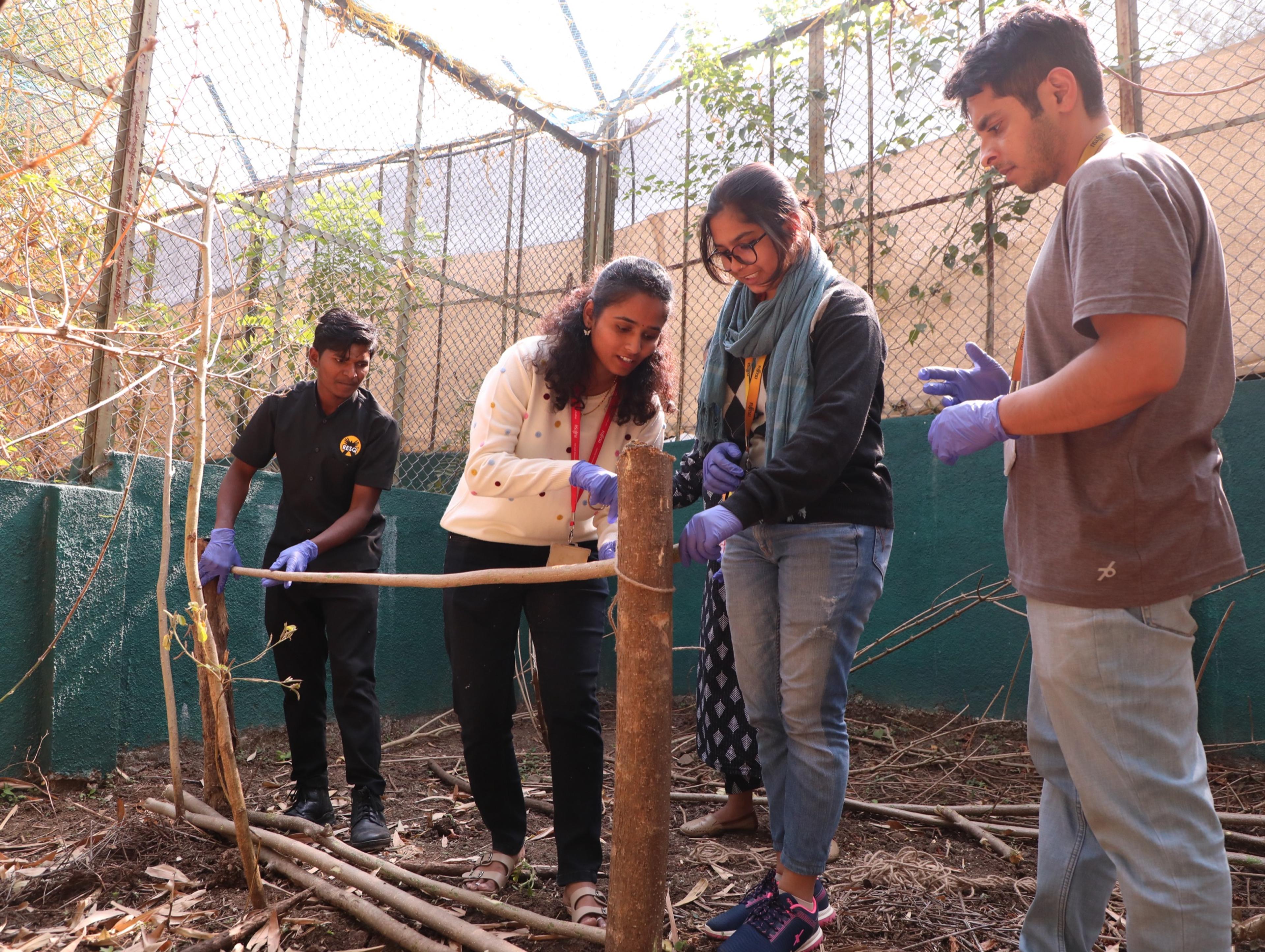
Corporate team day: a day of enclosure preparation, enrichment building, feed preparation and facility work, agreed in advance with our Community Engagement Officer. Groups of 20–25, phased across the day; your coordinator sends ID, a signed waiver and a list of attendees. There are no individual forms, interviews or certificates. NGOs, government departments and academic institutions are better served by an Insight Visit.
What you will learn
For qualified veterinarians and final-year veterinary students. You work alongside wildlife veterinarians and rehabilitators, observing and assisting under supervision in triage, examinations, diagnostics, anaesthesia, surgical assistance and post-operative care. What you may do on a given day is decided by the attending veterinarian and the animal in front of you.
For everyone else, including veterinary students before their final year. You work on husbandry, enrichment, feed preparation, enclosure maintenance and welfare records, and learn about human-wildlife coexistence, safe capture and transport. No specific degree is needed; a real interest in wildlife is enough.
| Veterinary Track | Applied Wildlife Management Track | |
|---|---|---|
| 1 | Wildlife handling, clinical examination and diagnostics, under supervision | How a wildlife rescue and rehabilitation centre runs, day to day |
| 2 | Surgical assistance, anaesthesia and post-operative recovery | Animal care, husbandry, feeding and enclosure management across species |
| 3 | Disease management, preventive medicine and treatment protocols for mammals, birds and reptiles | Behavioural enrichment, welfare assessment and rehabilitation techniques |
| 4 | Interpreting clinical findings and planning treatment and rehabilitation | Record-keeping and observation for rehabilitation monitoring |
| 5 | Medical records and digital case management | Human-wildlife coexistence, safe capture and transport, conflict mitigation |
| 6 | Ethics of intervention, treatment limits and release readiness | Awareness and education work in communities |
| 7 | Working with field rescuers, rehabilitators and administrative teams | Teamwork, time management and problem-solving |
| 8 | Confidence to practise ethical, science-based wildlife medicine | A deeper understanding of ethical wildlife care |
Check you are ready
| Age | What you need |
|---|---|
| 18 and over | You may take part independently |
| 16–17 | Written parental or guardian consent |
| 13–15 | Written parental or guardian consent, and a reference from a RESQ team member |
| Under 13 | Not eligible |
How it works
International placements follow the same steps, except that Worldwide Vets set your dates, send your pre-arrival pack and help with your visa.
Volunteer life
A day starts between 9 and 10 am, depending on your track, and ends between 6 and 7 pm: rounds, observations, assigned tasks, time with your mentor and an end-of-day reflection. The centre runs 24 hours a day and emergencies do not consult the roster; residential volunteers are sometimes asked to help outside routine hours, which is always optional. Rosters are set by RESQ around supervision and animal welfare. Daily reports go to your supervisor through the volunteer portal.
Volunteers and interns do not handle animals, give treatment, make clinical decisions or carry out rescues on their own. Interns who show progress may join field work, awareness programmes and releases under supervision; this is never guaranteed. Volunteering does not authorise you to rescue or care for a wild animal at home: if you find one in need, call +91 91725 11100.
You want hands-on animal handling or photos with wildlife; short, casual or tourism-style volunteering; or a guaranteed certificate. The work means long hours, lifting and bending outdoors in heat and rain, strong smells, and seeing animals that are badly injured or die. If you are going through mental or emotional difficulties that a high-stress setting could make worse, please talk to us first.
What matters most is not your background but your attitude: we look for people who follow instructions, keep to schedules, work as a team and put animal welfare first.
A Certificate of Participation is awarded for completing 7 to 28 days, or 50 hours within three months, at RESQ's discretion, and names your track. Hours are verified by our staff as you go; certificates are never issued in advance, and hours cannot be adjusted to meet a deadline. Student interns: send your institution's requirements with your application and we will tell you honestly whether we can meet them.
Taking part is not charged. Residential volunteers and interns pay for accommodation, food and utilities and contribute towards wildlife care; our Community Engagement Officer shares the exact costs after screening. International placement costs are set by Worldwide Vets.
Read the Code of Conduct, check you have your vaccination certificates, then apply.